Join the project community on our server!




OpenSnitch is a GNU/Linux application firewall.
•• Key Features • Download • Installation • Usage examples • In the press ••
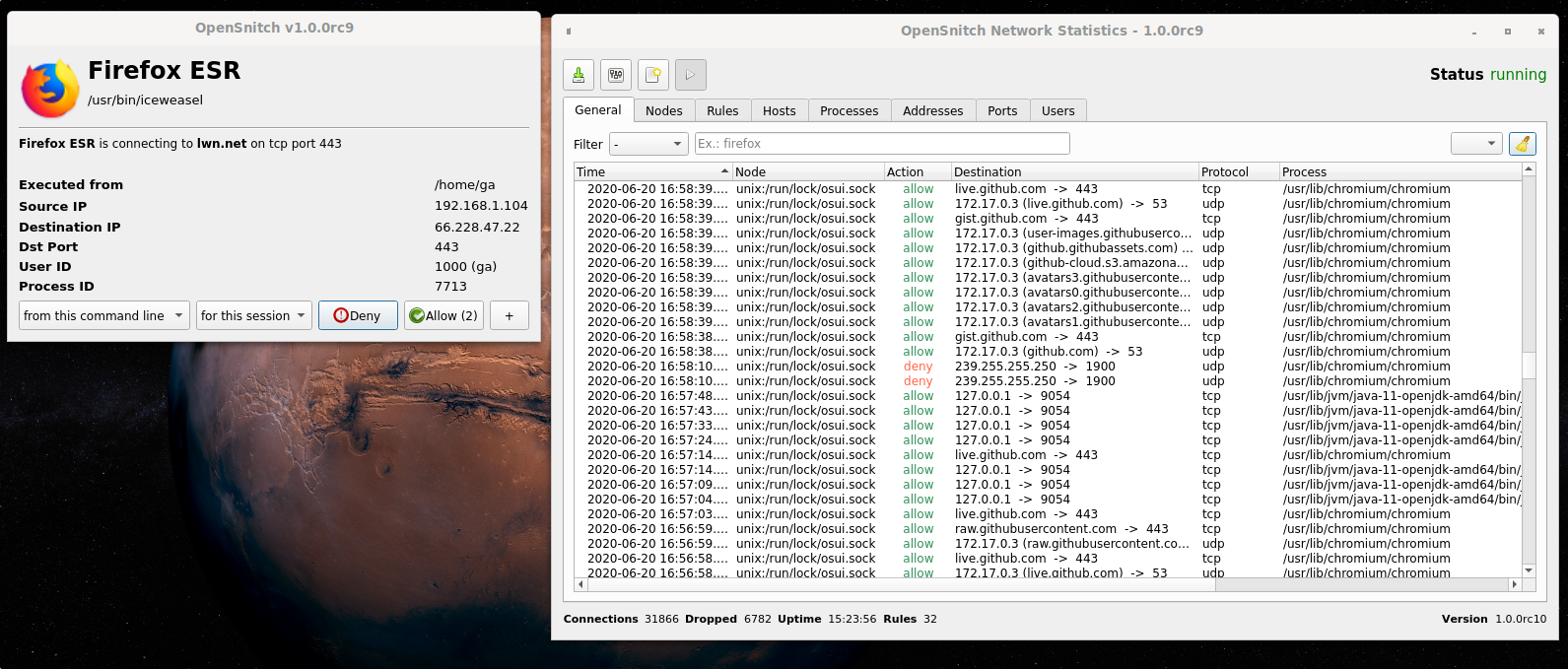
## Key features
* Interactive outbound connections filtering.
* [Block ads, trackers or malware domains](https://github.com/evilsocket/opensnitch/wiki/block-lists) system wide.
* Ability to [configure system firewall](https://github.com/evilsocket/opensnitch/wiki/System-rules) from the GUI (nftables).
- Configure input policy, allow inbound services, etc.
* Manage [multiple nodes](https://github.com/evilsocket/opensnitch/wiki/Nodes) from a centralized GUI.
* [SIEM integration](https://github.com/evilsocket/opensnitch/wiki/SIEM-integration)
## Download
Download deb/rpm packages for your system from https://github.com/evilsocket/opensnitch/releases
## Installation
### Daemon-only source build (maintained fork)
This maintained mirror defaults to the local native workflow: `make` builds the
Go daemon and all three eBPF objects; `sudo make install` installs both. Neither
command builds/installs the Python GUI or starts/restarts the service. Existing
policy and local unit files are preserved. PyQt and translation tools are not
required. Use `make all-with-ui` / `sudo make install-with-ui` only when you
explicitly want the desktop UI. Plain `make clean` cleans native outputs only;
`clean-with-ui` additionally removes generated Python protocol files. Install the native development dependencies
for libnetfilter_queue, libpcap and libmnl, Go, protobuf's `protoc`, and LLVM
(`clang`, `opt`, `llc`). The eBPF build also needs matching prepared kernel
headers and binutils' `readelf`.
Set up the pinned Go protocol generators once (their installation directory must
be on PATH), and download the pinned module dependencies explicitly:
```sh
go install google.golang.org/protobuf/cmd/protoc-gen-go@v1.34.1
go install google.golang.org/grpc/cmd/protoc-gen-go-grpc@v1.3.0
export PATH="$PATH:$(go env GOPATH)/bin"
(cd daemon && go mod download)
```
Normal builds now use `go build -mod=readonly`, not `go get`. Review dependency
file changes separately; builds do not silently update the module graph.
```sh
make
make check-install
```
The default header path is `/usr/lib/modules/$(uname -r)/build` for this Arch
machine. `KERNEL_VER`, `KERNEL_DIR` and `KERNEL_HEADERS` remain overridable; see
[ebpf_prog/README](ebpf_prog/README) for other distributions/split headers.
Each `make` rebuilds and structurally checks all three eBPF objects to avoid
stale objects after a kernel/toolchain change; it does not load them into the
running kernel. `make daemon-only` and `make ebpf` remain available separately. `check-install` uses
stub toolchains and temporary staging directories, never sudo or a live service.
After successful unprivileged builds, an operator can run:
```sh
sudo make install
# Operator-controlled activation, after reviewing the installed unit/config:
sudo systemctl daemon-reload
sudo systemctl restart opensnitchd
```
The daemon installer seeds missing configuration, rules and tasks but preserves
existing files/symlinks and local service units. It does not migrate or merge
policy. Neither native installer calls systemctl or starts/restarts the daemon;
review the intended configuration and unit, then reload/start the service
explicitly. The eBPF installer copies checked objects as built; optional debug
stripping is described in its README.
For an unprivileged package staging root, both targets honor `DESTDIR` and
`PREFIX`. For example, after building:
```sh
: "${pkgdir:?Set pkgdir to a private staging directory}" &&
test "$pkgdir" != / &&
make install-daemon DESTDIR="$pkgdir" PREFIX=/usr SYSTEMDUNITDIR=/usr/lib/systemd/system &&
make install-ebpf DESTDIR="$pkgdir" PREFIX=/usr
```
Here `pkgdir` must be an explicitly selected nonempty private staging directory;
this is a staging interface, not a complete Arch PKGBUILD. A package recipe must
also declare dependencies/configuration backup handling and be validated with
the distribution's tooling. A complete local Arch recipe is provided below.
### Local Arch daemon-only package
`utils/packaging/arch/prepare.sh` exports committed native sources plus the
reviewed Makefile/documentation overlays, generates the Go protocol with the
pins above, records provenance, and renders a checksum-pinned local PKGBUILD.
It refuses other uncommitted/untracked native source changes rather than
silently dropping them. It never copies the Python UI, host configuration,
existing object files or binaries, and never modifies the source checkout.
```sh
# Choose a NEW absolute output directory; keep the pinned generators on PATH.
sh utils/packaging/arch/prepare.sh /absolute/new/opensnitch-package
cd /absolute/new/opensnitch-package
# Review PKGBUILD and BUILD_SOURCE.txt inside the source archive first.
makepkg --nosign
```
Install the declared build dependencies yourself if missing. Do not use `-i`
or `-s` for a build-only check. Generation includes explicit `go mod download`
in prepare; compilation itself stays readonly. By default this builds against
`uname -r` headers; an intentional alternate target can be selected with
`OPENSNITCH_KERNEL_VERSION`. This is not proof of verifier/attachment acceptance
on another kernel. The source archive is reproducible for the same revision,
overlays, generator versions and source epoch; compiler/package reproducibility
is a separate check.
The package is `opensnitch-daemon-local` (x86_64, no GUI), conflicts with the
combined OpenSnitch packages, and marks shipped policy files as configuration
backups. It ships the unit under `/usr/lib/systemd/system` and has no service
activation script. Installing it is a separate operator decision. In
particular, a manual `/etc/systemd/system/opensnitchd.service` override pointing
to `/usr/local/bin` wins over the packaged unit: review migration explicitly;
never force-overwrite configuration or assume this package switched the live
binary. No automatic migration/deletion of manual installs is attempted.
#### deb
> $ sudo apt install ./opensnitch*.deb ./python3-opensnitch-ui*.deb
#### rpm
> $ sudo dnf install opensnitch*.rpm
Then run: `$ opensnitch-ui` or launch the GUI from the Applications menu.
Please, refer to [the documentation](https://github.com/evilsocket/opensnitch/wiki/Installation) for detailed information.
## OpenSnitch in action
Examples of OpenSnitch intercepting unexpected connections:
https://github.com/evilsocket/opensnitch/discussions/categories/show-and-tell
Have you seen a connection you didn't expect? [submit it!](https://github.com/evilsocket/opensnitch/discussions/new?category=show-and-tell)
## In the press
- 2017 [PenTest Magazine](https://twitter.com/pentestmag/status/857321886807605248)
- 11/2019 [It's Foss](https://itsfoss.com/opensnitch-firewall-linux/)
- 03/2020 [Linux Format #232](https://www.linux-magazine.com/Issues/2020/232/Firewalld-and-OpenSnitch)
- 08/2020 [Linux Magazine Polska #194](https://linux-magazine.pl/archiwum/wydanie/387)
- 08/2021 [Linux Format #280](https://github.com/evilsocket/opensnitch/discussions/631)
- 02/2022 [Linux User](https://www.linux-community.de/magazine/linuxuser/2022/03/)
- 06/2022 [Linux Magazine #259](https://www.linux-magazine.com/Issues/2022/259/OpenSnitch)
## Donations
If you find OpenSnitch useful and want to donate to the dedicated developers, you can do it from the **[Sponsor this project](https://github.com/sponsors/gustavo-iniguez-goya)** section on the right side of this repository.
You can see here who are the current maintainers of OpenSnitch:
https://github.com/evilsocket/opensnitch/commits/master
## Contributors
[See the list](https://github.com/evilsocket/opensnitch/graphs/contributors)
## Translating
